Subscribe to AI newsletter
Your data is completely secure with us. We don't share it with anyone.
Referent is AI-native legal practice management software. Legal AI agents handle the operational work while lawyers focus on clients and growth.
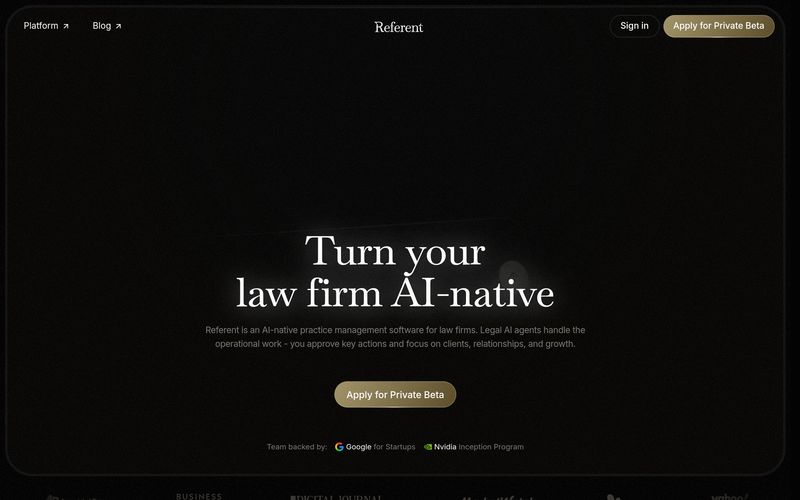
Referent AI: The AI Tool Transforming Modern Law Firms with Intelligent Legal Practice Management
Referent AI is an innovative AI tool built specifically for lawyers and law firms that want to modernize their legal operations without sacrificing client service or data security. Rather than acting as a simple assistant, Referent AI serves as an AI-native legal practice management platform that automates repetitive administrative work while keeping lawyers in complete control of every important legal decision.
Unlike traditional legal software that requires endless manual data entry, Referent AI allows lawyers to manage their practice using natural language or even voice commands. Simply tell the platform what needs to be done, and its intelligent Legal AI agents automatically create matters, update records, organize tasks, and maintain the firm's workflow. This dramatically reduces administrative overhead and gives lawyers more time to focus on clients, legal strategy, and business growth.
One of Referent AI's most valuable features is its AI-powered client intake system. The platform streamlines the entire pre-matter process by collecting client information, organizing relevant details, preparing engagement proposals, and even generating payment links automatically. This creates a faster, more professional onboarding experience while reducing manual work for legal staff.
Referent AI also integrates seamlessly with Google Workspace, including Gmail, Google Calendar, and Google Drive. Emails are automatically linked to the appropriate matter, meetings and court hearings stay synchronized across calendars, and legal documents become searchable within each case. Instead of spending valuable time organizing files or searching through inboxes, lawyers can instantly access all relevant communications and documents from a single matter.
Another standout capability is its intelligent CRM automation. Legal AI agents continuously update matter records, assign tasks, route work to the right people, and organize client information without requiring manual CRM maintenance. Every email, note, document, phone call, and file is automatically associated with the correct case, ensuring that nothing is lost or misplaced as workloads grow.
Whether you're a solo practitioner, boutique firm, or large enterprise law firm, Referent AI scales to fit different legal environments. Solo lawyers can operate with the efficiency of a much larger practice by letting AI manage routine operations. Boutique firms can standardize workflows across every attorney, while larger firms gain an AI operations layer that supports multiple practice groups with full audit trails and lawyer approval for critical actions.
Security and client confidentiality remain central to the platform. Referent AI is designed with legal ethics in mind by ensuring that firm data is never used to train AI models, never sold to third parties, and always remains under the firm's ownership. Every AI-generated action is logged, auditable, and subject to lawyer approval, giving firms complete transparency and control over automated processes.
As an advanced AI tool for lawyers, Referent AI combines artificial intelligence with professional legal judgment instead of replacing it. By automating operational tasks while preserving attorney oversight, the platform enables legal professionals to handle more matters, improve client experiences, increase operational efficiency, and build a truly AI-native law firm prepared for the future of legal practice.
An AI-native law firm is a firm where AI is built into daily operations, not just opened occasionally to draft a letter or summarize a document. In an AI-native firm, client emails become tasks, new intake turns into matters automatically, documents become summaries, and deadlines create their own reminders.
AI agents move the routine work forward in the background, while the lawyer reviews and approves every action that touches a client or carries real risk. The distinction is simple but decisive: an AI-assisted firm uses AI as a tool it picks up and puts down; an AI-native firm runs on AI as its operating layer, the way a modern business runs on its accounting system.
The practical result is leverage - the same lawyer and the same staff can carry far more matters without losing track, because the operational overhead that used to consume the day now runs itself.
Becoming AI-native takes three steps, in order. First, connect your firm's context - bring clients, matters, emails, documents, and deadlines into one system, so the AI works from your real practice rather than a blank prompt.
Second, hand your repetitive operations to AI agents: intake, follow-ups, task creation, deadline tracking, document filing, billing prep, and client updates are the usual starting points. Third, keep approval in the lawyer's hands - set rules so nothing client-facing or high-risk happens without your review.
Most firms begin by automating those seven routine workflows, prove the system on them, then widen the scope as trust builds. You do not rebuild your practice overnight, and you do not hand over judgment. With Referent, white-glove onboarding handles the setup and the connection work for you, so a firm can reach a working AI-native baseline in days rather than the months a self-serve tool would take.
Referent is built specifically for the transition to AI-native operations, not as a chatbot bolted onto legacy practice management software. It combines two layers that usually live in separate products.
The first is a legal CRM that holds your clients, matters, tasks, documents, and billing in one place. The second is an AI execution layer - voice commands and agents that actually move routine work forward, rather than just answering questions about it. Every agent works from your firm's live matter context, so it acts on your real clients and deadlines, and every critical action waits for a lawyer's approval before it leaves the firm.
Most legal software is a system of record: it stores what already happened and waits for you to do the next thing. Referent is a system of action - it makes the next thing happen, then asks you to approve it. That difference is why firms going AI-native choose it.
Referent's legal AI agents work from your firm's matter context - the clients, emails, documents, tasks, deadlines, and billing status already in your workspace. Each agent owns a specific routine: one handles intake, another routes and files client email, another drafts follow-ups, another tracks deadlines, another prepares billing.
The agent does the legwork and then stages the result for your review rather than acting on its own authority. You can trust them because of how they are constrained, not because you are asked to take them on faith. The rule is constant: AI prepares, the lawyer approves.
Any client-facing or high-risk action requires your explicit sign-off, every action is recorded in an audit trail you can inspect, and every draft can be edited or rejected before a word leaves your firm. The agents remove busywork and create leverage, but the professional judgment - and the final decision - stays with the lawyer.
Referent connects only to the Google services you choose, so your firm's operations can run in one place instead of being scattered across tabs. With Gmail access, Referent files incoming client correspondence to the right matter and sends the replies you have approved.
With Google Calendar access, it syncs hearings, meetings, and deadlines in both directions, so nothing lives in only one calendar. With Google Drive access, it makes the documents you connect searchable inside the related matter, where you actually need them.
The access is scoped to what each feature requires, and you grant each service deliberately. Referent uses Google data only to provide these features - never to train AI models, and never for advertising - and you can disconnect any service at any time, at which point the data synced from it is deleted. Confidentiality is the constraint the whole integration is designed around, not an afterthought.
Your firm's data lives in a secure, encrypted workspace that is isolated per firm, so one firm's information is never mixed with another's. Referent does not train AI models on your client data, and it does not sell, share, or monetize client information in any form.
No client-facing action happens without a lawyer's permission, and you control internal access through roles and permissions, so each team member sees only what their role allows. A full audit trail records what was created, changed, or sent, and by whom, which gives you a defensible record for your own compliance and ethics obligations. When you delete data, it is genuinely deleted, not archived out of sight.
Confidentiality is not treated as an add-on feature here - it is the design constraint everything else in the product is built around, because for a law firm, client trust is the asset that matters most.
A blank AI chat knows nothing about your firm - you paste context in, copy the answer out, and update your own systems by hand afterward. Referent works from your firm's live matter context instead: the clients, emails, documents, deadlines, tasks, and billing already in your workspace.
Ask it 'What needs my attention today?' and it answers from your actual practice, not from generic training data - and then it does the work rather than just describing it. It creates the matter, drafts the follow-up for your approval, files the document to the right place, and sets the reminder.
A chatbot is a smart assistant you have to direct turn by turn, and that re-enters everything manually. Referent is an operating layer that already holds your firm's state and moves routine work forward on its own, while keeping every client-facing action behind a lawyer's sign-off. Chatbots answer questions. Referent runs the operation.
Share practical notes and help others evaluate this tool.
No comments yet. Start the conversation.

Discover the best Lawyers AI Tools for legal professionals. Explore AI software for legal research, contract drafting, document review, case management, compliance, eDiscovery, legal writing, and law firm productivity. Compare the latest AI tools trusted by lawyers and legal teams.



This comprehensive guide explores the best AI image generators available in 2026, highlighting their unique features, strengths, and ideal use cases. We'll dive deep into each tool's capabilities to help you identify which AI image generator best suits your creative needs.

Google has just launched a powerful AI IDE code editor — now you can really vibe while coding

The best AI Model And AI Tools in 2026,The Most Popular Free AI Model And AI Tools.