Subscribe to AI newsletter
Your data is completely secure with us. We don't share it with anyone.
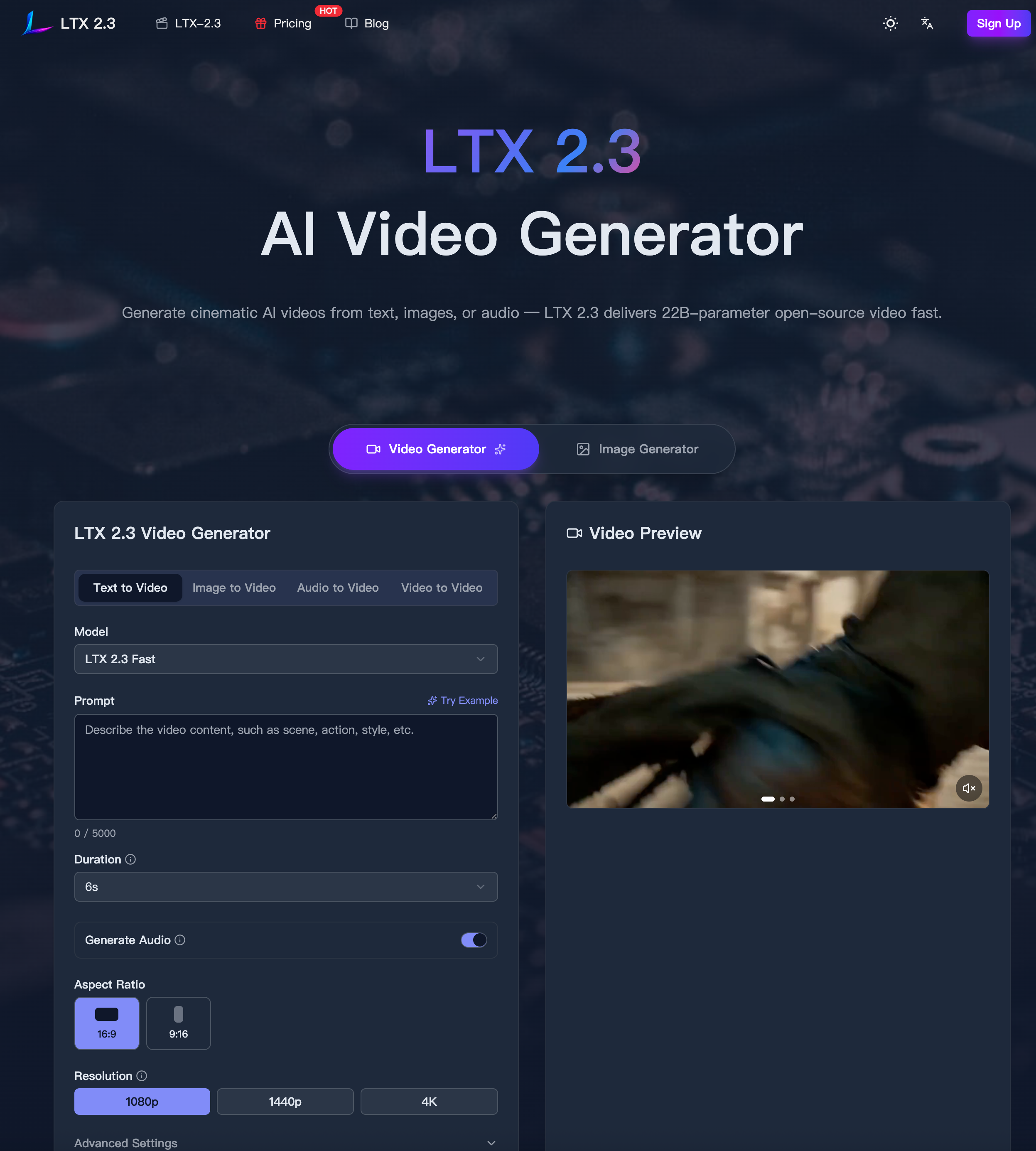
LTX 2.3 is one of the most advanced open-source AI tool platforms currently reshaping the Video Generation industry. Developed on a massive 22-billion-parameter Diffusion Transformer (DiT) architecture by Lightricks, LTX 2.3 combines cinematic-quality rendering, multi-modal generation capabilities, and remarkably fast processing speeds into a single AI-powered creative ecosystem. For creators, marketers, filmmakers, game developers, and content studios searching for scalable AI video production, LTX 2.3 stands out as a next-generation solution built for both speed and professional-quality output.
One of the biggest highlights of LTX 2.3 is its incredible rendering performance. According to the platform, the model runs approximately 18 times faster than WAN 2.2 on H100 GPUs, making it one of the fastest open-source Video Generation models available today. This speed advantage is especially important for creators handling large production workloads, social media campaigns, advertising content, or cinematic storytelling projects. Instead of waiting hours for rendering, users can generate high-quality AI videos within minutes while maintaining fluid motion, realistic lighting, and natural physics simulation.
Unlike many traditional AI video tools that focus only on text-to-video generation, LTX 2.3 supports a complete multi-modal workflow. Users can create videos from text prompts, animate still images into cinematic motion clips, synchronize visuals with audio tracks, perform video-to-video transformations, and even apply depth conditioning for more advanced scene control. This versatility makes the AI tool highly valuable for multiple industries including filmmaking, e-commerce, social media marketing, animation, game development, and product advertising.
Another major strength of LTX 2.3 is its native portrait video support at 1080x1920 resolution. Instead of simply cropping landscape footage, the model was trained directly on real portrait-oriented data, allowing creators to generate vertical videos optimized for TikTok, Instagram Reels, and YouTube Shorts. This feature gives social media creators and digital marketers a huge advantage when producing platform-specific AI-generated content.
The quality improvements in LTX 2.3 are also extremely impressive. The rebuilt VAE and expanded latent space produce sharper textures, cleaner edges, improved hair details, and more consistent character rendering across frames. The upgraded 4x text connector significantly improves prompt understanding, allowing the AI tool to interpret complex scene descriptions, spatial layouts, mood direction, and character actions with much higher accuracy. As a result, creators can produce cinematic scenes with professional-level continuity and visual storytelling.
Accessibility is another reason why LTX 2.3 is gaining attention in the AI tool community. Since rendering can be fully cloud-based, users do not need expensive local GPUs or complex workstation setups to access advanced Video Generation capabilities. At the same time, developers and advanced users still have the option to run LTX 2.3 locally through ComfyUI workflows, FP8 optimization, GGUF quantized models, and downloadable Hugging Face checkpoints.
Commercial flexibility further strengthens the appeal of LTX 2.3. The platform allows commercial usage with no watermarks or royalty fees, making it highly attractive for businesses, agencies, and production studios. Combined with open-source accessibility, cinematic output quality, ultra-fast rendering, and multi-modal generation support, LTX 2.3 positions itself as one of the most competitive AI tool solutions in the rapidly evolving Video Generation market.
LTX 2.3 is rapidly becoming one of the most exciting AI tool platforms in the modern Video Generation industry. What makes LTX 2.3 especially impressive is its ability to combine cinematic-quality AI video production with extremely fast rendering performance and open-source accessibility. Built on a massive 22-billion-parameter Diffusion Transformer architecture, the platform delivers advanced AI-generated videos that feature realistic motion, detailed textures, accurate lighting, and natural physics simulation. For creators, marketers, filmmakers, and developers looking for scalable AI-powered video production, LTX 2.3 represents a major leap forward in AI video technology.
One of the strongest advantages of this AI tool is its speed. According to the platform, LTX 2.3 runs up to 18 times faster than WAN 2.2 on H100 GPUs, making it one of the fastest open-source Video Generation models currently available. This performance boost is extremely valuable for creators who need to generate large amounts of content quickly for advertising campaigns, social media marketing, game trailers, cinematic storytelling, or e-commerce product videos. Faster rendering means lower production time, improved workflow efficiency, and significantly reduced creative costs.
Another major strength of LTX 2.3 is its multi-modal generation pipeline. Unlike many AI video platforms that focus only on text-to-video creation, LTX 2.3 supports text-to-video, image-to-video, audio-to-video, video-to-video transformation, and advanced depth conditioning workflows. Users can upload a single image and transform it into a dynamic cinematic scene, or synchronize video generation directly with audio tracks for accurate lip-sync and beat-aligned animation. This versatility gives the AI tool broad commercial applications across entertainment, social media, gaming, advertising, and digital branding industries.
The quality improvements introduced in LTX 2.3 are also highly impressive. The rebuilt VAE and expanded latent space produce sharper textures, cleaner edges, improved facial consistency, and more stable character animation across frames. The upgraded 4x text connector significantly improves prompt understanding, allowing users to describe complex scenes, emotional tones, character movement, and spatial layouts with much greater accuracy. As a result, creators can generate professional-looking cinematic sequences without extensive post-production work.
LTX 2.3 is also particularly valuable for modern social media creators because it supports native 1080x1920 portrait video generation. Instead of relying on cropped landscape footage, the model is trained directly on real vertical-format data, making it ideal for TikTok, Instagram Reels, and YouTube Shorts. This native portrait optimization helps creators produce mobile-first Video Generation content that looks more natural and engaging on vertical platforms.
Another important advantage is accessibility. Since the platform supports cloud rendering, users do not need expensive GPUs or high-end editing hardware to use the AI tool effectively. At the same time, advanced developers can still run LTX 2.3 locally through ComfyUI integrations, Hugging Face checkpoints, FP8 optimization, and GGUF quantized models for custom workflows.
Overall, LTX 2.3 stands out as a highly advanced AI tool that combines open-source flexibility, cinematic quality, ultra-fast rendering, and multi-modal Video Generation capabilities into a single platform. Its ability to generate professional AI videos from text, images, and audio makes it one of the most competitive solutions in the rapidly evolving AI video creation market.


This comprehensive guide explores the best AI image generators available in 2026, highlighting their unique features, strengths, and ideal use cases. We'll dive deep into each tool's capabilities to help you identify which AI image generator best suits your creative needs.
Google has just launched a powerful AI IDE code editor — now you can really vibe while coding

The best AI Model And AI Tools in 2026,The Most Popular Free AI Model And AI Tools.