Subscribe to AI newsletter
Your data is completely secure with us. We don't share it with anyone.
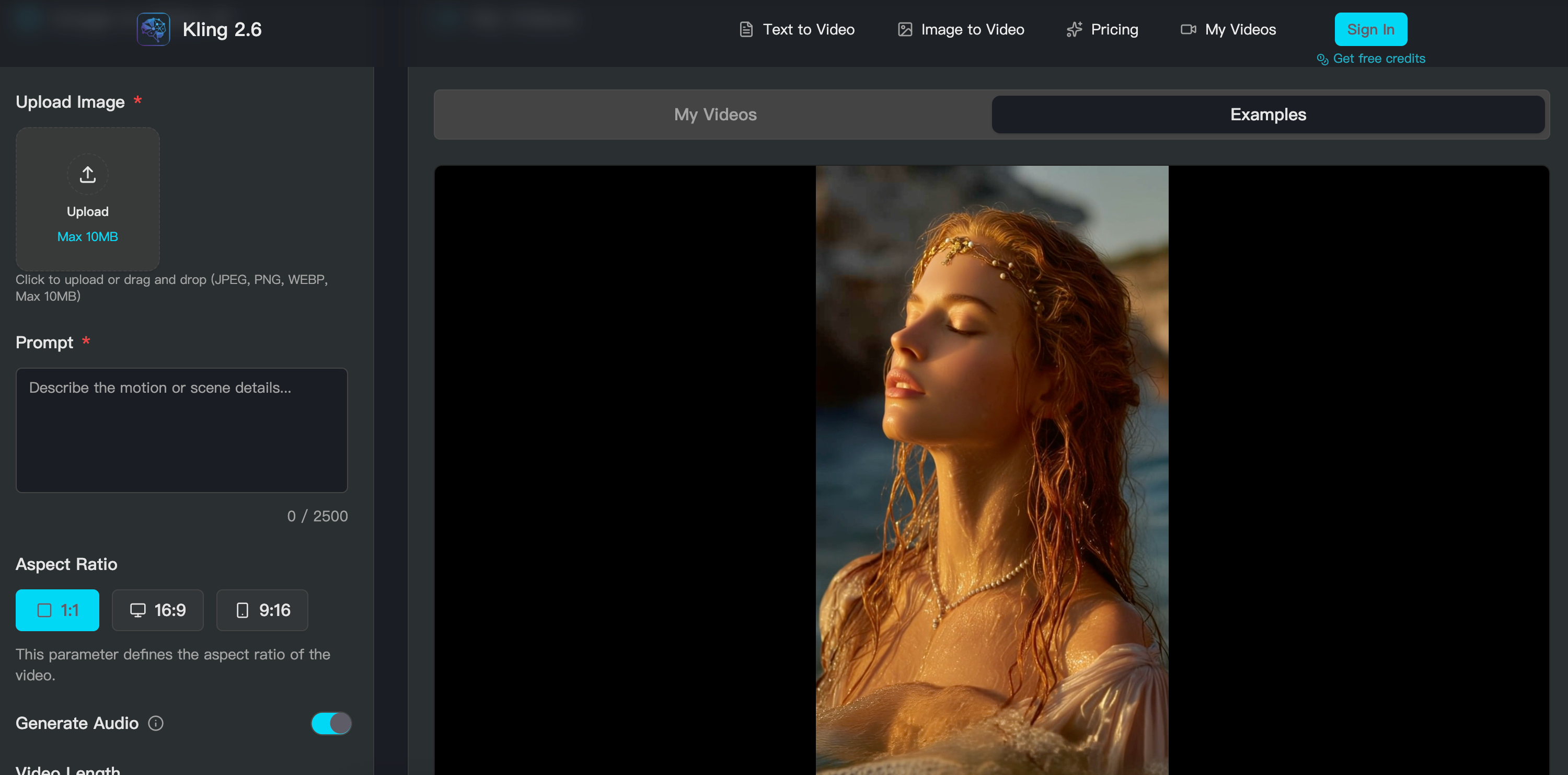
In the rapidly advancing field of digital media, Kling 2.6 has emerged as a powerhouse AI tool designed to redefine the boundaries of Video Generation. By leveraging a revolutionary hybrid architecture that fuses Diffusion Models with Transformer networks, the platform allows creators to transform simple text or image prompts into broadcast-quality content without requiring technical expertise.
What makes Kling 2.6 a standout AI tool is its unprecedented level of control over the Video Generation process. Unlike traditional models that struggle with consistency, Kling 2.6 utilizes 3D spatiotemporal attention mechanisms to ensure deep spatial understanding and perfect temporal coherence across every frame. Key technical highlights include:
Kling 2.6 distinguishes itself in the Video Generation market by offering native, perfectly synchronized audio capabilities. The platform delivers 1:1 lip-synchronization for both Chinese and English, ensuring that facial expressions and mouth movements align perfectly with generated voices. Furthermore, its bilingual audio engine supports voice cloning and automatic sound effect generation, creating a rich, immersive atmosphere without the need for traditional post-production.
Designed for the speed of social media, this AI tool specializes in 5-second and 10-second formats tailored for TikTok, Instagram Reels, and YouTube Shorts. With generation speeds as fast as 2–3 seconds and a native 1080P output, Kling 2.6 reduces production time by an estimated 80%. For developers, a comprehensive RESTful API enables seamless integration into modern frameworks like Next.js and React, making it a versatile solution for high-frequency Video Generation needs.
In the rapidly evolving ecosystem of creative technology, Kling 2.6 stands out as a remarkably powerful AI tool that pushes the boundaries of modern Video Generation. As digital storytelling increasingly shifts toward automated and AI-assisted production, Kling 2.6 demonstrates how an advanced architecture can dramatically simplify the process of turning ideas into visually compelling video content. By combining the strengths of Diffusion Models and Transformer networks in a hybrid system, this AI tool allows creators to transform simple text or image prompts into dynamic video sequences with minimal effort. For designers, marketers, and social media creators, this significantly lowers the barrier to entry for high-quality Video Generation.
One of the most impressive aspects of Kling 2.6 is its technical precision. Many existing AI video tools struggle with maintaining visual consistency between frames, but Kling 2.6 addresses this challenge through sophisticated 3D spatiotemporal attention mechanisms. This technology enables the AI tool to understand both spatial relationships and temporal movement, ensuring that objects remain stable and logically animated across every frame. Features such as Multi-Element Tracking, which allows control of up to six moving objects simultaneously, and Motion Path Drawing, where creators can sketch movement trajectories directly onto an image, provide an unprecedented level of creative control in the Video Generation process. Additionally, the Static Area Locking feature ensures that background elements remain stable while specific parts of the scene animate, greatly improving visual realism.
Another area where Kling 2.6 excels as an AI tool is its integrated audio-visual synchronization. High-quality Video Generation often requires complex post-production to align voice and animation, but Kling 2.6 streamlines this with native lip-sync technology that works seamlessly in both Chinese and English. Its bilingual voice engine, voice cloning capabilities, and automatic sound effect generation allow creators to produce immersive multimedia experiences without relying on multiple external tools.
Equally important is the platform’s optimization for modern content formats. Short-form video has become the dominant format on platforms like TikTok and YouTube Shorts, and Kling 2.6 is designed specifically for this environment. With generation times of just a few seconds and native 1080P output, the AI tool can reduce production time by up to 80%. Combined with its developer-friendly RESTful API and compatibility with frameworks such as React and Vue, Kling 2.6 proves to be not just a creative platform but a scalable solution for high-frequency Video Generation workflows in today’s fast-paced digital landscape.


This comprehensive guide explores the best AI image generators available in 2026, highlighting their unique features, strengths, and ideal use cases. We'll dive deep into each tool's capabilities to help you identify which AI image generator best suits your creative needs.
Google has just launched a powerful AI IDE code editor — now you can really vibe while coding
The best AI Model And AI Tools in 2026,The Most Popular Free AI Model And AI Tools.