Kling 2.6 Frequently Asked Questions

Kling 2.6

What is Kling 2.6 and how does it differ from other AI video generators?

Kling 2.6 is the flagship AI video generation model developed by Kuaishou's Kling AI team, representing cutting-edge video technology.

Key Differentiators:

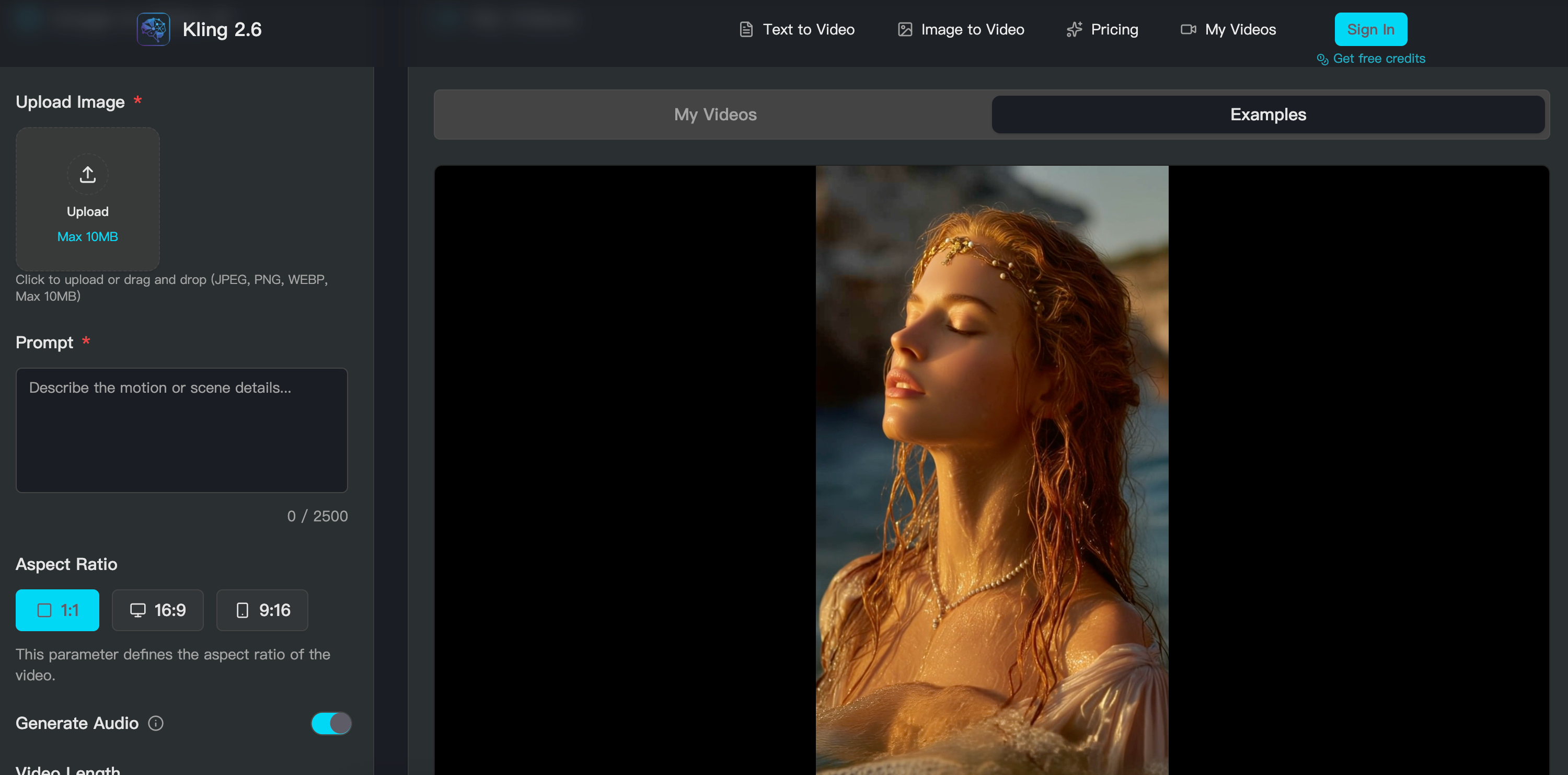
  • End-to-end audio-visual synchronous generation - Kling 2.6 creates complete videos with perfectly synchronized voice, sound effects, and ambient audio in a single unified process
  • Advanced precision motion control with path drawing and static area locking capabilities
  • Native 1080P high-definition output without requiring upscaling or enhancement
  • Custom voice cloning technology for creating unique character voices
  • Bilingual audio support for Chinese and English with multiple speech styles

Unlike traditional AI video tools that generate video first and require separate audio production steps, Kling 2.6 revolutionizes the workflow by generating everything simultaneously. This eliminates time-consuming post-production work and ensures perfect synchronization between visual and audio elements.


What video formats and resolutions does Kling 2.6 support?

Kling 2.6 generates videos in professional broadcast quality with the following specifications:

Video Output:

  • Native 1080P high-definition resolution
  • Standard MP4 format for universal compatibility
  • Audio embedded directly into video file
  • No secondary enhancement or upscaling required

Duration Options:

  • 5-second videos - optimized for quick social media content
  • 10-second videos - ideal for marketing materials and product demos

These duration settings are specifically designed for social media platforms, marketing campaigns, and short-form content strategies that dominate modern digital marketing. The native 1080P resolution ensures Kling 2.6 videos maintain professional appearance across all platforms and devices without additional processing.

Current Limitations:

  • No 4K output support (optimized for 1080P)
  • Maximum duration of 10 seconds per video
  • Focus on short-form content optimization


How does the Kling 2.6 motion control system work?

The Kling 2.6 precision motion control system provides unprecedented control over object movement and scene dynamics:

Visual Path Drawing:

  • Draw custom movement trajectories directly on input images
  • Control up to 6 independent moving elements simultaneously
  • Each element can have unique motion paths and parameters
  • Intuitive brush interface for natural workflow

Static Area Locking:

  • Designate areas that should remain fixed and stable
  • Prevent unwanted movement in backgrounds or stationary objects
  • Ensure consistent scene composition throughout video

Text-Assisted Motion Control:

  • Define motion parameters through natural language prompts
  • Specify speed, direction, acceleration, and action types
  • Examples: 'slow rotation clockwise' or 'linear movement from left to right'
  • Combine visual paths with semantic instructions for maximum precision

This dual control system combines visual path drawing with text-based instructions, giving creators complete control over every aspect of motion in Kling 2.6 generated videos. The system solves common AI video problems like stiff movements, illogical object floating, and unwanted scene penetration.


What languages and audio capabilities does Kling 2.6 support?

Kling 2.6 offers comprehensive bilingual audio generation with advanced voice technology:

Supported Languages:

  • Chinese - full native support
  • English - full native support

Audio Generation Types:

  • Monologue narration for single-voice content
  • Multi-character dialogue for conversational videos
  • Professional voiceover narration
  • Singing vocals with musical accompaniment
  • Rap performances with rhythm matching
  • Mixed audio combining multiple sound layers
  • Pure sound effects generation
  • Ambient sound design and environmental audio

Custom Voice Cloning:

  • Upload 10-30 seconds of voice samples
  • Kling 2.6 trains personalized voice profiles
  • Maintain consistent character voices across multiple videos
  • Create branded character voices for business content
  • Use cloned voices in both Chinese and English

The voice cloning capability enables creators to produce branded content, character-driven narratives, and personalized video messages at scale. All audio is perfectly synchronized with visual elements through Kling 2.6's end-to-end generation process.


How much does it cost to use Kling 2.6?

Kling 2.6 offers competitive pricing through multiple platform providers:

Third-Party Platform Pricing:

  • 5-second video without audio: $0.28
  • 5-second video with audio: $0.55
  • 10-second video without audio: $0.55
  • 10-second video with audio: $1.10

Official Kuaishou Pricing:

  • Slightly higher than third-party rates
  • Guaranteed access to all advanced features
  • Priority processing and support
  • Full custom voice cloning capabilities

Cost-Saving Options:

  • Bulk credit purchases provide 10-20% discounts
  • High-volume commercial accounts get preferential rates
  • No setup fees or monthly minimums

Value Comparison: Kling 2.6 dramatically reduces overall video production costs by eliminating post-production audio work, reducing creation time by up to 80%, and delivering broadcast-ready output without additional enhancement. When factoring in time savings and elimination of post-production costs, Kling 2.6 represents one of the most cost-effective professional AI video generation solutions available.


Can I integrate Kling 2.6 into my own application or website?

Yes, Kling 2.6 provides comprehensive API integration options for developers:

API Technology:

  • Standard RESTful API architecture
  • JSON request and response format
  • Comprehensive documentation and code examples
  • SDKs available for popular languages

Framework Compatibility:

  • Next.js and React applications
  • Node.js backend services
  • Vue and Angular frontends
  • Python-based systems and automation
  • Any platform supporting HTTP requests

Integration Options:

  • Direct official API through Kuaishou
  • Third-party platform providers

Third-Party Advantages:

  • Higher concurrency limits (10-20+ simultaneous requests)
  • Official API limited to 5 concurrent requests
  • Simplified billing and account management
  • Additional developer tools and dashboards
  • Better suited for high-traffic commercial applications

API Capabilities:

  • Text-to-video generation
  • Image-to-video conversion
  • Motion control configuration
  • Audio settings and voice cloning
  • Real-time generation status monitoring
  • Webhook notifications for completion

The Kling 2.6 API enables developers to embed powerful video generation capabilities directly into their platforms, products, and automated workflows.


What are the technical limitations of Kling 2.6?

While Kling 2.6 represents cutting-edge AI video technology, understanding its limitations ensures optimal usage:

Duration Constraints:

  • Maximum video length: 10 seconds
  • Optimized for short-form content
  • Not suitable for long-form video production
  • Focus on social media and marketing content

Language Support:

  • Audio generation: Chinese and English only
  • No support for Spanish, French, German, Japanese, or other languages
  • Text prompts can be in any language but audio limited to Chinese/English

Audio Export:

  • Audio embedded in MP4 video file only
  • No separate audio file export option
  • Requires video editing software to extract audio if needed

Content Complexity:

  • Complex multi-person interactions may show minor imperfections
  • Intricate choreography with many characters can be challenging
  • Ultra-realistic film-level detail may have occasional artifacts
  • Best suited for simplified scenes with focused subjects

Optimal Use Cases:

  • Social media short-form content
  • Marketing videos and advertisements
  • Product demonstrations and explainers
  • Educational content snippets
  • Animated presentations

Not Ideal For:

  • Long-form documentary production
  • Feature-length film creation
  • Complex multi-character theatrical scenes
  • Content requiring multiple languages beyond Chinese/English


How fast is Kling 2.6 video generation and processing?


Kling 2.6 delivers industry-leading generation speeds enabling rapid content production:

Standard Generation Times:

  • 5-second videos: 2-3 seconds generation time
  • 10-second videos: 4-6 seconds generation time
  • Simple scenes: faster processing
  • Complex scenes: slightly longer processing

Motion Control Processing:

  • Motion path calculations: sub-500 millisecond latency
  • Real-time motion preview available
  • Instant feedback on motion path adjustments

Factors Affecting Speed:

  • Video complexity and number of elements
  • Audio requirements (synchronized audio adds minimal time)
  • Custom voice cloning parameters
  • Motion control complexity
  • Current platform load and queue
  • API provider infrastructure

Production Efficiency:

  • Generate multiple video variations in minutes
  • Rapid iteration on creative concepts
  • Quick A/B testing of different approaches
  • Same-day production of marketing campaigns
  • Real-time response to trending topics

Comparison to Traditional Production:

  • Traditional video production: days to weeks
  • Conventional AI video tools: minutes to hours (plus post-production)
  • Kling 2.6: seconds to minutes (no post-production needed)

The exceptional speed of Kling 2.6 enables creators and businesses to produce, iterate, and publish video content at unprecedented velocity, making it ideal for fast-paced marketing campaigns and responsive content strategies.


What makes Kling 2.6 suitable for professional business and commercial use?


Kling 2.6 is specifically engineered for professional business applications and commercial video production:

Business-Grade Features:

  • Consistent high-quality output for brand standards
  • Native 1080P resolution for professional appearance
  • Reliable performance for production workflows
  • Scalable API infrastructure for high-volume needs

Cost Efficiency:

  • Dramatically lower than traditional video production
  • Eliminate post-production audio costs
  • Reduce production time by 80%
  • Scalable pricing for any budget
  • No equipment or studio costs

Brand Consistency:

  • Custom voice cloning for branded character voices
  • Consistent visual quality across all content
  • Maintain brand identity in every video
  • Template-based workflows for repeatable results

Integration Capabilities:

  • RESTful API for marketing automation
  • Integration with content management systems
  • Automated video generation workflows
  • Batch processing for campaign content
  • Webhook notifications for production pipelines

Speed to Market:

  • Rapid response to market trends
  • Same-day campaign production
  • Quick iteration on creative concepts
  • A/B testing multiple versions efficiently
  • Real-time content for trending topics

Scalability:

  • Generate dozens of videos simultaneously
  • Support multiple teams and projects
  • Handle seasonal campaign spikes
  • Scale production without additional resources

Professional Use Cases:

  • Social media marketing campaigns
  • Product launch videos
  • E-commerce product demonstrations
  • Educational and training content
  • Customer testimonial videos
  • Explainer videos for services
  • Event promotion materials
  • Internal communications

These capabilities make Kling 2.6 the ideal platform for businesses requiring scalable, cost-effective, high-quality video content production without the complexity and expense of traditional production methods.

Summary and Review:

In the rapidly evolving landscape of digital creativity, Kling 2.6 represents a new generation of AI tool technology that is redefining the standards of modern Video Generation. Unlike many traditional AI video platforms that separate visual creation from audio production, Kling 2.6 introduces a truly end-to-end system capable of generating fully synchronized videos—including voice, sound effects, and ambient audio—in a single unified workflow. This integrated approach makes the AI tool particularly valuable for creators, marketers, and developers who need to produce professional content quickly without complicated post-production processes.


One of the most compelling aspects of Kling 2.6 as an AI tool is its advanced motion control technology. Through an intuitive path-drawing system and static area locking, users can precisely control how objects move within a scene. This means that creators can design complex animations, control up to six moving elements simultaneously, and maintain background stability throughout the Video Generation process. The addition of text-assisted motion commands—such as specifying speed, direction, or rotation—further enhances creative flexibility. Together, these features solve common problems seen in earlier AI video models, such as unnatural movement, floating objects, or inconsistent scene composition.


Another reason Kling 2.6 stands out in the AI tool ecosystem is its comprehensive audio capability. The platform supports bilingual audio generation in both Chinese and English, including narration, multi-character dialogue, singing, rap, and environmental sound design. Perhaps even more impressive is the voice cloning functionality, which allows creators to upload short voice samples and generate consistent, branded voices across multiple videos. This greatly expands the possibilities for character-driven storytelling and scalable marketing content in modern Video Generation workflows.


From a production standpoint, Kling 2.6 is optimized for today’s short-form content economy. With native 1080P resolution, MP4 output, and generation speeds of only a few seconds, this AI tool enables rapid experimentation and high-volume content production. Businesses can create social media ads, product demonstrations, or educational snippets almost instantly. Additionally, the platform’s RESTful API allows seamless integration into modern development frameworks, enabling automated Video Generation pipelines within websites, applications, and marketing systems.


Overall, Kling 2.6 demonstrates how a well-designed AI tool can transform the entire Video Generation workflow. By combining synchronized audio-visual creation, precise motion control, fast processing speeds, and scalable developer integration, it offers a powerful solution for both individual creators and professional organizations seeking efficient, high-quality video production.

Subscribe to AI newsletter
Your data is complely secured with us. We don't share with anyone.