Subscribe to AI newsletter
Your data is completely secure with us. We don't share it with anyone.
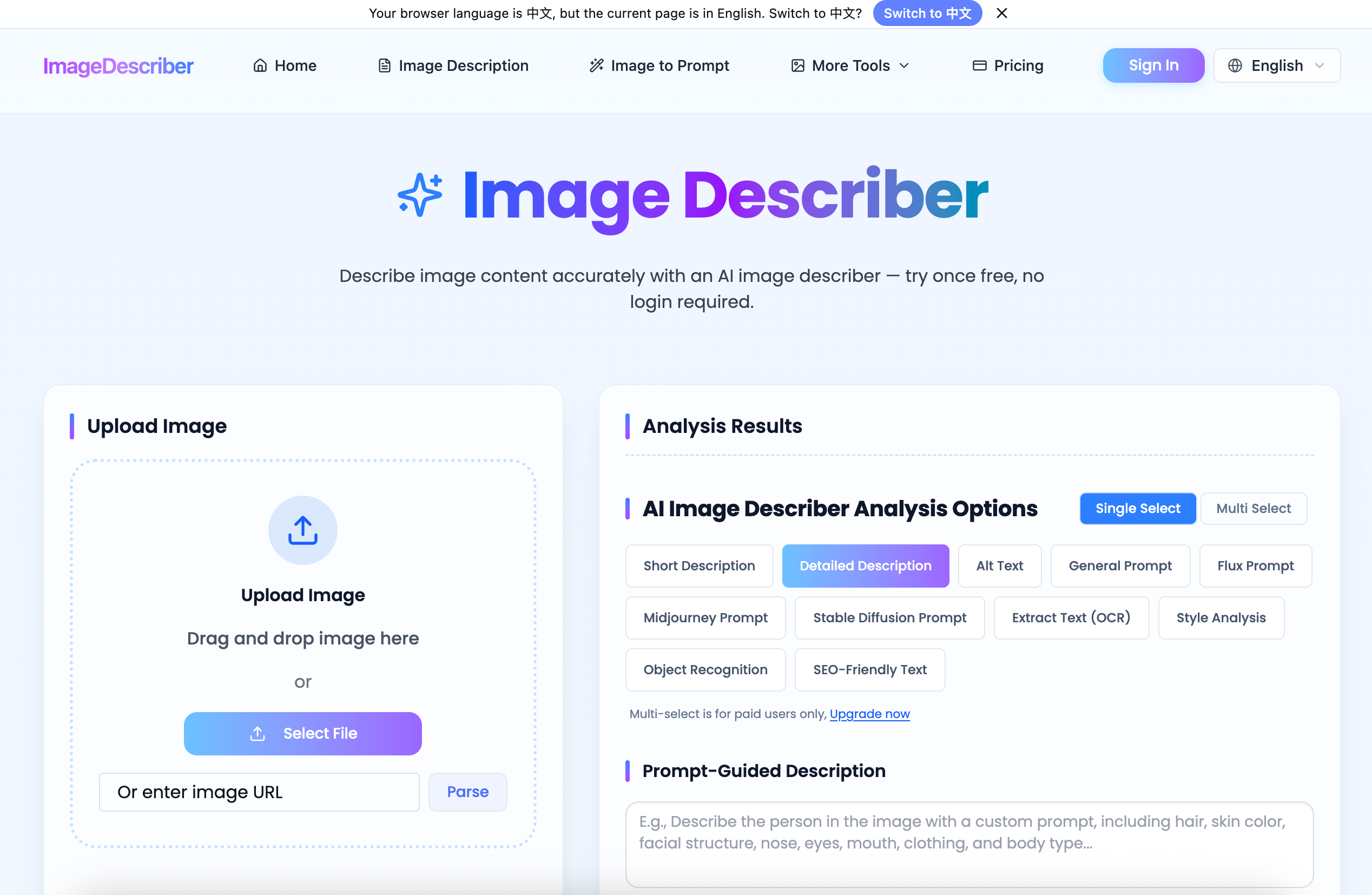
An AI image describer is a tool that uses artificial intelligence to analyze visual content and generate clear, natural language descriptions of what is happening in an image.
AI describes an image accurately by processing visual signals, identifying objects, and understanding scene context to produce a detailed and objective summary.
Yes. This image describer is specifically designed to generate WCAG-compliant alt text, making it a powerful tool for visual accessibility.
The image describer can generate short and detailed descriptions, alt text, image-based prompts, and structured text outputs.
AI describes an image by processing millions of visual data points to recognize shapes, colors, and relationships, turning them into natural language.
Yes. Modern AI models can describe an image with deep context, explaining not just what objects are present, but also the overall mood and scene narrative.
Image Describer is a highly practical AI tool that plays an important role in bridging visual understanding and structured text output within modern Image Generation workflows. Based on its FAQ, the tool is designed to analyze images using artificial intelligence and transform visual data into clear, natural language descriptions. This capability is not only useful for interpretation but also for powering downstream creative, accessibility, and automation tasks.
At its core, this AI tool works by processing visual signals such as shapes, colors, objects, and spatial relationships. Through advanced pattern recognition and contextual modeling, it converts complex image data into coherent and objective summaries. This level of accuracy is essential in Image Generation ecosystems, where understanding composition, lighting, and scene structure can directly influence prompt quality and creative outcomes.
One of the most valuable features highlighted in the FAQ is its support for accessibility. Image Describer can generate WCAG-compliant alt text, making digital content more inclusive for visually impaired users. This positions it not just as a creative tool, but also as an accessibility-focused solution that aligns with modern web standards and ethical content practices.
Beyond basic descriptions, the tool is capable of producing multiple types of outputs, including short summaries, detailed explanations, SEO-friendly text, and image-based prompts. This versatility is particularly useful in Image Generation workflows, where descriptive text can be reused to recreate visuals, guide AI models, or enhance content discoverability across search engines.
Another key strength is its contextual understanding. Rather than simply listing objects, the system interprets deeper meaning—such as mood, narrative, and scene dynamics—resulting in richer and more human-like descriptions. This makes it especially valuable for creative professionals who rely on nuanced visual interpretation.
Overall, Image Describer stands out as a powerful AI tool that enhances Image Generation workflows by turning raw visual input into meaningful, structured, and actionable text. It supports creativity, accessibility, and efficiency, making it an essential component in modern AI-driven content ecosystems.


This comprehensive guide explores the best AI image generators available in 2026, highlighting their unique features, strengths, and ideal use cases. We'll dive deep into each tool's capabilities to help you identify which AI image generator best suits your creative needs.
Google has just launched a powerful AI IDE code editor — now you can really vibe while coding
The best AI Model And AI Tools in 2026,The Most Popular Free AI Model And AI Tools.