Subscribe to AI newsletter
Your data is completely secure with us. We don't share it with anyone.
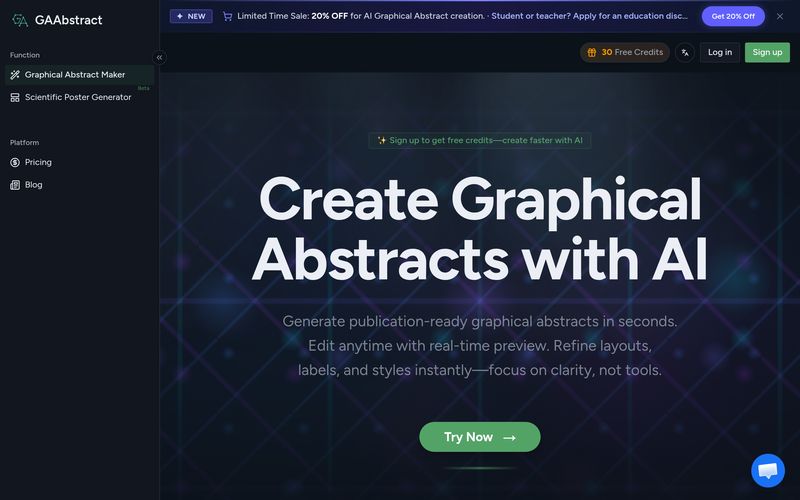
A graphical abstract is a single visual summary of a paper’s key message—often used by journals, conferences, and labs to help readers understand the main result at a glance.
Upload your paper PDF or paste your abstract. GAAbstract analyzes the content and automatically generates the most suitable structure. Then refine labels, icons, and layout before exporting.
Yes. GAAbstract uses AI to extract key entities, steps, and results from your abstract or PDF, then drafts a structured graphical abstract. You can review, edit, and export when ready.
Yes. You can create graphical abstracts you can drop into slide decks and share online. Many users generate an animated graphical abstract to explain the key result quickly.
No. AI drafting helps you start with a strong layout. You can then adjust the parts that matter—terminology, labels, and emphasis—without rebuilding everything.
That’s the goal. Reuse styles (colors, typography, icon style) and a proven structure so every graphical abstract follows the same visual language, even across multiple papers and collaborators.
A common classification is: descriptive (what the paper covers), informative (methods + results + conclusions), critical (adds evaluation), and highlight (emphasizes key takeaways). Some journals also use structured abstracts with section headings.
A poster is a multi-section presentation (background, methods, results) designed to be read and discussed at an event. A graphical abstract is usually a single-panel visual summary meant to convey one main message quickly in a paper, on slides, or on social media.
In modern academic publishing, presenting complex research findings clearly and efficiently has become more important than ever. Scientific papers are often dense and highly technical, making it difficult for readers to quickly understand the key message. This is where GAAbstract stands out as a highly practical AI tool for scientific Image Generation, helping researchers transform detailed research into clear, visually engaging graphical abstracts with minimal effort.
A graphical abstract is essentially a single visual summary of a research paper’s key findings, commonly used by journals, conferences, laboratories, and research institutions to communicate scientific results at a glance. Instead of forcing readers to process long blocks of text, a graphical abstract highlights the most important concepts through structured visuals. GAAbstract simplifies this traditionally difficult process by using AI to understand research content and automatically generate publication-ready visual drafts.
One of the strongest advantages of GAAbstract is its AI-driven workflow. Users simply upload a research PDF or paste an abstract into the platform, and the system intelligently extracts entities, relationships, methods, and outcomes from the scientific text. Rather than starting from an empty canvas, the AI automatically drafts a structured graphical abstract, significantly reducing the time researchers spend organizing information manually.
What makes GAAbstract especially valuable as an AI tool for Image Generation is that users do not need professional design skills. After the initial draft is generated, researchers can refine labels, terminology, icons, layouts, and emphasis areas without rebuilding everything from scratch. This balance between automation and customization allows users to maintain scientific precision while improving clarity and visual quality.
Another major benefit is the platform’s flexibility across communication channels. Graphical abstracts created with GAAbstract can be reused in journal submissions, conference presentations, academic slide decks, and even social media posts for broader science communication. Many users also create animated graphical abstracts to explain findings in a faster and more engaging format.
For research teams and laboratories, consistency is another major strength. GAAbstract supports reusable visual systems, allowing labs to standardize typography, colors, layouts, and icon styles across multiple papers and collaborators. This creates a stronger visual identity and improves professionalism across research outputs.
Overall, GAAbstract is an excellent AI tool for scientific Image Generation, offering researchers a faster, smarter, and more accessible way to produce professional graphical abstracts while preserving scientific accuracy, visual consistency, and communication clarity.

This comprehensive guide explores the best AI image generators available in 2026, highlighting their unique features, strengths, and ideal use cases. We'll dive deep into each tool's capabilities to help you identify which AI image generator best suits your creative needs.
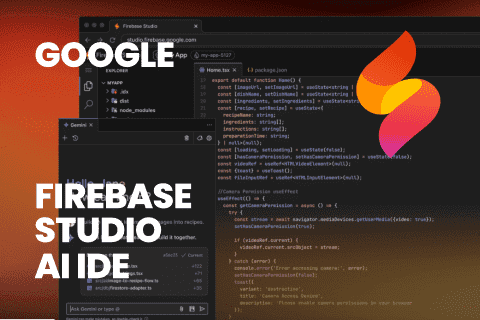
Google has just launched a powerful AI IDE code editor — now you can really vibe while coding
The best AI Model And AI Tools in 2026,The Most Popular Free AI Model And AI Tools.